

From Productivity to Genuine AI Action: A Conversation with Dr. Indra Pradana Singawinata and Professor Akira Igata
- APO Genuine AI Action
- Nov 19, 2025
- 4 min read
Updated: Mar 18
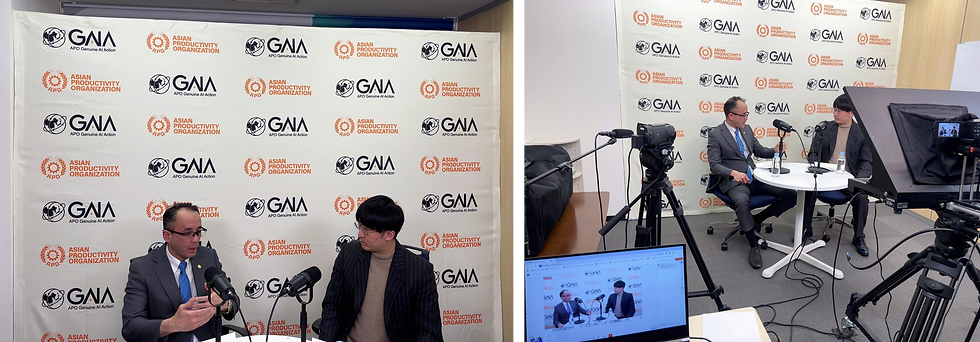
On 29 January 2026, the launch of the Genuine AI Action (GAIA) Podcast Series marks a significant milestone in the Asian Productivity Organization’s (APO) efforts to advance practical, inclusive, and responsible artificial intelligence (AI) across the Asia-Pacific.
In the inaugural episode, Professor Akira Igata of the University of Tokyo engages in a wide-ranging discussion with Dr. Indra Pradana Singawinata, Secretary-General of the APO, exploring how AI can move beyond theory to deliver tangible impact on productivity and socioeconomic development.
“Productivity Is More Than Efficiency”
Professor Akira Igata: Many viewers may not yet be familiar with the APO. Could you briefly explain what the organization does and its role in the region?
Dr. Indra Pradana Singawinata: The Asian Productivity Organization was established in 1961 and currently comprises 21 member economies across Asia and the Pacific. Our core mission is to enhance productivity through policy advisory services, capacity-building initiatives, research, and regional cooperation. Importantly, productivity is not simply about efficiency or output. It is about enabling long-term socioeconomic development that is inclusive, sustainable, and resilient.
Professor Igata: Why does productivity remain such a critical issue today?
Dr. Indra Pradana Singawinata: Productivity underpins economic growth, competitiveness, and public service delivery. Today, economies are facing structural challenges—aging populations, climate change, supply chain disruptions, and rapid technological shifts.
In this context, productivity growth is essential, and increasingly, it is driven by digital transformation and artificial intelligence.
“AI Is Already Transforming Our Economies—But a Gap Remains”
Professor Igata:What motivated APO to launch GAIA at this point in time?
Dr. Indra Pradana Singawinata:AI is no longer a future technology—it is already reshaping governments, industries, and labor markets. However, we identified a critical gap. On one side, there are highly advanced technical discussions among AI experts. On the other, policymakers, SMEs, and public-sector practitioners are seeking practical guidance on how to adopt AI responsibly. GAIA was designed to bridge this gap.
Professor Igata:The term “Genuine AI Action” is quite distinctive. What does “genuine” signify?
Dr. Indra Pradana Singawinata:“Genuine” reflects our intention to move beyond AI as a buzzword.
It emphasizes:
Practical application rather than abstract discussion
Responsible and safe deployment
Inclusive access across diverse economies
GAIA focuses on how AI is actually implemented, governed, and applied in real-world settings to improve productivity.
“GAIA as an Integrated Platform”
Professor Igata:Could you elaborate on the structure of GAIA?
Dr. Indra Pradana Singawinata:GAIA is structured around four core pillars.
First, the GAIA Podcast Series, which serves as a public-facing platform for dialogue with AI leaders.
Second, the GAIA AI Ecosystem Map, which analyzes the full AI value chain—from models and infrastructure to data and financing.
Third, the GAIA Global Policy Network, which facilitates exchange among governments, researchers, and international organizations on AI governance and policy.
Finally, the GAIA Summit, to be held in Tokyo in October 2026 in collaboration with the United Nations University.
Professor Igata:Why was a podcast chosen as a central pillar?
Dr. Indra Pradana Singawinata:Accessibility is key. Many stakeholders may not engage with technical reports, but they can access insights through conversations.
The podcast allows us to:
Humanize complex AI topics
Provide direct insights from practitioners
Translate expertise into actionable knowledge
It also feeds directly into broader GAIA activities, including policy discussions and the Summit.
“AI Requires a Multi-Sector Approach”
Professor Igata:GAIA places strong emphasis on multi-sector engagement. Why is this important?
Dr. Indra Pradana Singawinata:AI cannot be addressed in isolation.
It involves:
Academia, which drives research and innovation
Governments, which develop policies and regulatory frameworks
International organizations, which shape global governance
The private sector, which develops and deploys AI technologies
GAIA reflects this interconnected ecosystem. It is not about endorsements, but about facilitating meaningful dialogue among key stakeholders.
“Balancing Innovation with Governance”
Professor Igata:How does GAIA address concerns related to AI risks and governance?
Dr. Indra Pradana Singawinata:We emphasize that AI for productivity and AI governance must advance together.
Through GAIA, we promote:
Ethical and safe AI deployment
Strong data governance and transparency
Capacity building for public institutions and regulators
Our role is to support member economies in understanding trade-offs and developing appropriate policy responses.
Professor Igata:How does this approach differ in the Asia-Pacific context?
Dr. Indra Pradana Singawinata:The region is highly diverse. Some economies are at the technological frontier, while others are still building foundational capacity. GAIA recognizes these differences and avoids a one-size-fits-all approach, making it uniquely suited to the Asia-Pacific.
“Toward the GAIA Summit 2026”
Professor Igata:What can audiences expect from the GAIA Podcast Series moving forward?
Dr. Indra Pradana Singawinata:They can expect engagement with a wide range of stakeholders, including AI companies, policymakers, international organizations, and researchers.
Each episode will focus on practical AI—how it is designed, deployed, and governed.
Professor Igata:And how does this connect to the GAIA Summit?
Dr. Indra Pradana Singawinata:The Summit represents the culmination of GAIA. The podcast helps identify key issues, build partnerships, and shape an agenda grounded in real-world experience.
By October 2026, GAIA will already function as an active and evolving platform.
Conclusion
The inaugural GAIA Podcast episode highlights a clear strategic direction:
to move from conceptual discussions on AI toward practical, inclusive, and responsible implementation.
Through sustained dialogue and collaboration, GAIA aims to ensure that artificial intelligence serves as a meaningful driver of productivity and sustainable development across the Asia-Pacific.


Comments